

Years ago, a NAS motherboard mainly meant a basic desktop board with extra drive connectors. Now, compact server platforms pack serious storage, networking, and virtualization potential into purpose-built designs.
That shift makes the best motherboards for nas a much more varied group, with real differences in capacity, connectivity, and upgrade paths. The comparison ahead helps you sort those details before your storage plans grow larger than the case.
Key Takeaways
- Check CPU socket and chipset compatibility before choosing a board, especially if you plan to use a desktop processor or an integrated low-power chip.
- Prioritize the number of native SATA ports and confirm whether included SFF-8643 connectors require separate breakout cables.
- Choose 2.5GbE for general home use, but consider 10GbE or dual 10GbE for large file transfers, editing, and multi-user workloads.
- Match DDR4 or DDR5 support to your budget and capacity needs, while checking the board's maximum memory limit.
- Confirm the mini-ITX or ATX form factor, PCIe layout, cooling requirements, and power connections will fit your NAS chassis.
| Efficient Storage Hub |  |
Unbranded Quad-Core NAS Board | Eight SATA connections | Dual 2.5GbE networking | Two M.2 slots | View on Amazon | Read Review |
| Expandable DDR5 Platform | 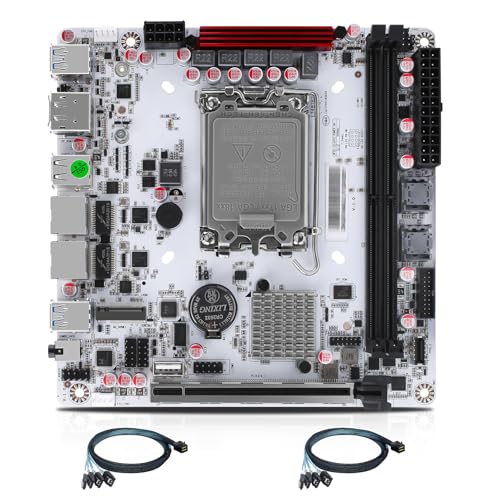 |
StoneStorm Q670 NAS Board | Supports modern Intel CPUs | Three M.2 slots | 20Gbps USB-C | View on Amazon | Read Review |
| Compact High-Speed Link |  |
N150 NAS Motherboard 10GbE | One 10Gbps network port | Two 2.5Gbps ports | Eight SATA connections | View on Amazon | Read Review |
| Enterprise Storage Backbone |  |
oaknode W680 12-Bay Board | Supports twelve drive bays | Four DDR5 slots | vPro remote management | View on Amazon | Read Review |
| Ready-Made 10GbE Build |  |
StoneStorm N150 8-Bay Board | Dedicated 10GbE networking | Dual 2.5GbE ports | Includes SFF-8643 cables | View on Amazon | Read Review |
| Flexible Ryzen Foundation |  |
GIGABYTE B550 AM4 Board | Broad Ryzen compatibility | PCIe 4.0 support | Wi-Fi 6 included | View on Amazon | Read Review |
| Multi-Network Mini Server |  |
N150 Triple-LAN NAS Board | Three integrated network ports | Eight SATA ports | DDR5 memory support | View on Amazon | Read Review |
| High-Performance NAS Core |  |
MINISFORUM BD775i Ryzen Board | Eight-core Ryzen processor | PCIe 5.0 x16 slot | Triple display output | View on Amazon | Read Review |
| Dual-Link File Server |  |
N150 Six-Bay Dual-10GbE Board | Dual 10GbE connectivity | Three M.2 slots | Includes cooling fan | View on Amazon | Read Review |
| Versatile Media Server | |
MINISFORUM BD775i DDR5 Board | Powerful eight-core CPU | Dual PCIe 4.0 M.2 | 8K triple-display support | View on Amazon | Read Review |
More Details on Our Top Picks
-
Unbranded Quad-Core NAS Board
For a compact home server, this board offers a practical mix of eight SATA connections, dual 2.5GbE networking, and a low-power quad-core, eight-thread processor. The two M.2 NVMe slots can support fast cache or system storage, while HDMI and DisplayPort outputs simplify local setup.
It suits home NAS builds, firewall appliances, and light virtualization workloads. The main limitation is the low-power CPU, which may feel constrained under demanding virtual machines, media transcoding, or many simultaneous users.
- Brand:Unbranded
- Processor:Quad-core, 8-thread CPU
- Form Factor:Mini-ITX
- Drive Bays:8 SATA
- Network Speed:Dual 2.5GbE
- Memory Type:DDR4
- Additional Feature:HDMI and DisplayPort
- Additional Feature:4K display support
- Additional Feature:PCIe x4 slot
-
StoneStorm Q670 NAS Board
Choose this board if you want a NAS that can grow beyond basic file storage. Its LGA1700 socket supports 12th, 13th, and 14th Gen desktop processors, while DDR5 support, three M.2 slots, and eight SATA ports leave room for a capable storage server.
The i226-LM 2.5GbE controller adds business-focused networking, and the USB-C port reaches 20Gbps for fast external storage. You will need to supply a compatible processor, and the Mini-ITX layout can make cable management crowded in an eight-drive build.
- Brand:StoneStorm
- Processor:LGA1700, 12th-14th Gen
- Form Factor:Mini-ITX
- Drive Bays:8 SATA
- Network Speed:2.5GbE
- Memory Type:DDR5
- Additional Feature:Dual 4K display output
- Additional Feature:i226-LM vPro networking
- Additional Feature:Three USB 3.2 ports
-
N150 NAS Motherboard 10GbE
This N150-based board targets compact NAS builds that need more network headroom than standard 2.5GbE provides. It combines eight SATA connections with one 10Gbps network port and two additional 2.5Gbps ports, a useful arrangement for file serving, backups, and network segmentation.
Two M.2 NVMe slots add room for caching or boot storage, and the included SFF-8643 connectivity points toward a tidy multi-drive design. The N150 processor is suited to efficient NAS duties, but it is not the right choice for heavy workstation workloads or numerous demanding virtual machines.
- Brand:Not specified
- Processor:Intel N150
- Form Factor:Mini-ITX
- Drive Bays:8 SATA
- Network Speed:10GbE plus 2.5GbE
- Memory Type:Not specified
- Additional Feature:Two M.2 NVMe slots
- Additional Feature:Two PCIe 3.0 connections
- Additional Feature:10Gbps USB-C
-
oaknode W680 12-Bay Board
For a larger storage server or workstation-style NAS, this ATX W680 board provides the broadest expansion potential in the group. Four DDR5 slots, three NVMe connections, twelve drive-bay support, and 10Gbps networking create a strong foundation for high-capacity storage and professional workloads.
Dual 2.5GbE ports and vPro remote management add useful administration options, especially for a server kept away from your desk. The ATX format requires a larger chassis, and the listing does not identify the included processor, so the final system will depend heavily on your CPU choice.
- Brand:oaknode
- Processor:Not specified
- Form Factor:ATX
- Drive Bays:12
- Network Speed:10GbE plus 2.5GbE
- Memory Type:DDR5
- Additional Feature:Three NVMe connections
- Additional Feature:Two HDMI outputs
- Additional Feature:Two DisplayPort outputs
-
StoneStorm N150 8-Bay Board
StoneStorm packs a lot of storage connectivity into this compact N150 platform, including eight-bay support, dual 2.5GbE ports, and a dedicated 10GbE AQC113C network controller. That combination is well suited to fast home labs, media libraries, and multi-user file transfers.
The two M.2 2280 slots, PCIe x4 slot, and included SFF-8643 cables simplify expansion planning. Its 48GB DDR5 maximum is useful for a small server, although the integrated N150 processor keeps this board focused on efficient NAS and network duties rather than demanding compute work.
- Brand:StoneStorm
- Processor:Intel N150
- Form Factor:Mini-ITX
- Drive Bays:8 SATA
- Network Speed:10GbE plus 2.5GbE
- Memory Type:DDR5
- Additional Feature:Two M.2 2280 slots
- Additional Feature:PCIe x4 expansion slot
- Additional Feature:10Gbps USB-C
-
GIGABYTE B550 AM4 Board
Unlike the purpose-built NAS boards here, this ATX B550 motherboard is a general PC platform that can become a capable storage server with the right case and expansion cards. Support for Ryzen 3000, 4000, and 5000 processors gives you a broad CPU selection, while PCIe 4.0 and two M.2 slots support fast storage.
Integrated Wi-Fi 6, USB-C, and Gigabit Ethernet make the feature set useful for a home server or workstation. The main drawback is storage connectivity: with only two onboard M.2 slots and no stated multi-SATA backplane support, you may need an HBA or add-in network card for a serious NAS build.
- Brand:GIGABYTE
- Processor:Ryzen 3000-5000
- Form Factor:ATX
- Network Speed:Gigabit Ethernet
- Memory Type:DDR4
- Additional Feature:Two M.2 slots
- Additional Feature:USB-C connectivity
- Additional Feature:10+3 power phase
-
N150 Triple-LAN NAS Board
This Mini-ITX board is built for buyers who want three network interfaces without adding a separate NIC. It combines one 10GbE port with two i226-V 2.5GbE ports, giving you useful flexibility for storage traffic, management, firewall duties, or link separation.
Eight SATA ports and two M.2 NVMe slots cover the core NAS requirements, while the PCIe x4 slot leaves room for another controller or accelerator. The N150 processor favors low power consumption and everyday server tasks, so demanding virtualization workloads may require a stronger platform.
- Brand:Not specified
- Processor:Intel N150
- Form Factor:Mini-ITX
- Drive Bays:8 SATA
- Network Speed:10GbE plus dual 2.5GbE
- Memory Type:DDR5
- Additional Feature:Two SFF-8643 connections
- Additional Feature:M.2 E-Key Wi-Fi slot
- Additional Feature:HDMI and DisplayPort
-
MINISFORUM BD775i Ryzen Board
For a NAS that also serves as a workstation or virtualization host, this board brings a much stronger Ryzen 7 7745HX processor than the low-power platforms in this roundup. Its eight cores and sixteen threads, DDR5 memory, and PCIe 5.0 x16 slot provide plenty of compute and expansion capacity.
Dual PCIe 4.0 M.2 slots support fast boot or cache storage, and triple 8K display output broadens its desktop potential. The limitation is storage connectivity on the board itself, since the listing specifies a 2.5GbE port but does not identify a large bank of SATA connections.
- Brand:MINISFORUM
- Processor:Ryzen 7 7745HX
- Form Factor:Mini-ITX
- Network Speed:2.5GbE
- Memory Type:DDR5
- Additional Feature:Dual PCIe 4.0 M.2
- Additional Feature:HDMI, DisplayPort, USB-C
- Additional Feature:USB 3.2 connectivity
-
N150 Six-Bay Dual-10GbE Board
This compact board is a strong match for a storage server built around dual 10GbE networking. The Intel X550-AT2 controller gives high-speed connectivity, while six SATA ports and three M.2 NVMe slots support a balanced mix of hard drives, SSDs, boot media, and cache.
The Mini-ITX format helps keep the enclosure compact, and the included fan and SFF-8643 cable support a more complete build. Six drive connections limit total capacity compared with eight- or twelve-bay options, and the N150 processor is aimed at efficient serving rather than heavy compute.
- Brand:Not specified
- Processor:Intel N150
- Form Factor:Mini-ITX
- Drive Bays:6 SATA
- Network Speed:Dual 10GbE
- Memory Type:DDR5
- Additional Feature:X550-AT2 network controller
- Additional Feature:4K HDMI output
- Additional Feature:SFF-8643 cable included
-
MINISFORUM BD775i DDR5 Board
This second BD775i SE listing uses the same core platform, making it a strong option for a high-performance NAS that also handles media work, development, or desktop tasks. The Ryzen 7 7745HX supplies eight cores and sixteen threads, while PCIe 5.0 and DDR5 provide a modern base for expansion.
Dual PCIe 4.0 M.2 slots are useful for fast system and cache storage, and the 8K triple-display support is unusual for a NAS-oriented board. As with the other listing, the board offers only a stated 2.5GbE port and does not specify numerous onboard SATA ports, so a dedicated storage controller may be necessary for a larger array.
- Brand:MINISFORUM
- Processor:Ryzen 7 7745HX
- Form Factor:Mini-ITX
- Network Speed:2.5GbE
- Memory Type:DDR5
- Additional Feature:PCIe 5.0 x16 slot
- Additional Feature:HDMI, DisplayPort, USB-C
- Additional Feature:USB 3.2 port
Frequently Asked Questions
How many SATA ports should a NAS motherboard have?
For a small NAS, four to six SATA ports usually cover the boot drive and a modest storage pool. Choose eight or more if you expect to add disks, use a separate cache device, or avoid buying an HBA later. Also check whether the board disables SATA ports when you install an M.2 drive. The advertised port count is useful, but the motherboard manual reveals the configuration that actually matters.
Is ECC memory necessary for a home NAS?
ECC is not mandatory for every home NAS, but it adds a useful layer of data protection by correcting many single-bit memory errors. It is especially sensible for large storage pools, ZFS-based systems, important business files, or machines that run continuously. You need ECC support from the processor, motherboard, and operating system. Confirm all three before spending extra on ECC modules, because compatibility is a team sport and memory cannot carry the whole roster.
Do I need 10GbE for a NAS?
You do not need 10GbE for ordinary backups, office documents, photos, and media streaming, where 1GbE or 2.5GbE may be sufficient. Faster networking becomes worthwhile for large file transfers, video editing, several active users, or SSD-based storage. The rest of the network must support the same speed. Budget for a compatible switch, network adapters, cabling, and storage performance, otherwise the 10GbE port may spend much of its life waiting politely.
Should I choose Mini-ITX, Micro-ATX, or ATX?
Choose Mini-ITX for compact systems with limited drive and expansion needs. Micro-ATX is often the practical choice for a home NAS because it offers more memory and PCIe flexibility without requiring a large case. ATX makes sense for many drives, multiple expansion cards, or a more elaborate server build. Before buying, match the board to the case, drive cages, cooler height, power supply, and available airflow.
Can a gaming motherboard work in a NAS?
Yes, a gaming motherboard can work well if it provides the required SATA ports, expansion slots, network hardware, and operating-system support. It may also offer useful processor performance for containers, virtual machines, or media transcoding. Watch for unnecessary power use, limited ECC support, shared storage lanes, and firmware settings that are less server-focused. A board designed for gaming is not automatically unsuitable, but a lower-power platform may cost less to run over several years.