
The screen stays dark, the fans spin, and your carefully chosen DDR5 kit sits ready while the motherboard decides whether to cooperate. That familiar pause is where a smart platform choice matters most.
This roundup brings together the best budget ddr5 motherboards across AMD and Intel systems, from compact builds to feature-packed ATX machines. The comparison ahead makes the trade-offs easier to spot, so keep reading before your next build turns into a parts-bin mystery.
Key Takeaways
- Confirm the motherboard’s CPU socket matches your processor generation before comparing features or prices.
- Choose an ATX or microATX form factor that fits your case and leaves enough room for future upgrades.
- Check the listed DDR5 speed and support for EXPO or XMP, since memory compatibility affects setup and performance.
- Count the available M.2 slots and PCIe lanes if you plan to add multiple SSDs, expansion cards, or a larger graphics card.
- Prioritize the connectivity you actually use, including Wi-Fi, Ethernet speed, USB-C, and BIOS flashback.
| Balanced AM5 Foundation |  |
Gigabyte B650 AORUS Elite AX | AM5 Ryzen support | PCIe 5.0 M.2 | Wi-Fi 6E | View on Amazon | Read Review |
| Memory Bundle Pick | 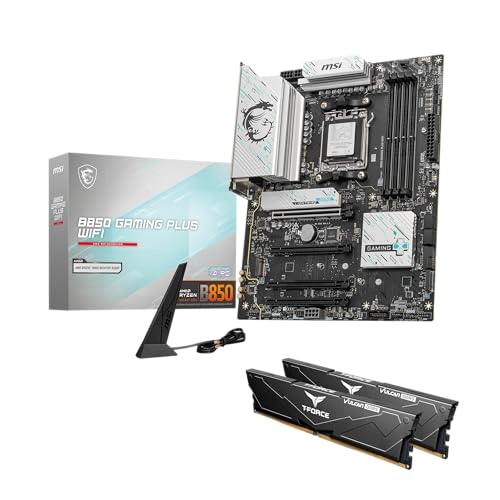 |
MSI B850 Gaming Plus WiFi | Includes 32GB DDR5 | Wi-Fi 7 | 5G LAN | View on Amazon | Read Review |
| Intel Expansion Leader | Gigabyte Z790 AORUS Elite AX | Four M.2 slots | Strong power delivery | Wi-Fi 6E | View on Amazon | Read Review | |
| Storage-Friendly Value |  |
Gigabyte B650 Eagle AX | Triple M.2 storage | PCIe 5.0 support | USB-C connectivity | View on Amazon | Read Review |
| High-Speed Networking |  |
MSI B850 Gaming Plus WiFi | 5G wired networking | Wi-Fi 7 | Gen5 M.2 | View on Amazon | Read Review |
| Stylish Creator Platform |  |
ASUS ROG Strix B650-A | Three M.2 slots | White ROG styling | 2.5GbE networking | View on Amazon | Read Review |
| Durable Upgrade Base |  |
ASUS TUF Gaming B850-PLUS | Three M.2 slots | Wi-Fi 7 | BIOS Flashback | View on Amazon | Read Review |
| Compact AM5 Builder |  |
Gigabyte B850M Eagle WiFi6E | Compact microATX design | PCIe 5.0 support | 2.5GbE LAN | View on Amazon | Read Review |
| Entry Intel Compact | Gigabyte H810M S2H Gen5 | Compact microATX format | PCIe 5.0 x16 | Front USB-C | View on Amazon | Read Review | |
| Premium Storage Option |  |
ASUS ROG Strix B850-A | Four M.2 slots | Wi-Fi 7 | 14+2+2 power stages | View on Amazon | Read Review |
More Details on Our Top Picks
-
Gigabyte B650 AORUS Elite AX
For a mainstream AM5 gaming build, this board offers a strong mix of upgrade room, connectivity, and storage support. The 14+2+1 power phase design suits Ryzen 7000, 8000, and 9000 processors, while PCIe 5.0 M.2 support gives fast storage a clear path forward.
You also get Wi-Fi 6E, 2.5GbE, USB-C, and practical assembly features such as EZ-Latch and Q-Flash. Its main limitation is that the feature set is broad rather than specialized, so buyers seeking multiple next-generation expansion slots may need a pricier platform.
- Brand:Gigabyte
- Socket:AM5
- Form Factor:ATX
- Memory Type:DDR5
- Wireless:Wi-Fi 6E
- Additional Feature:14+2+1 power phase
- Additional Feature:2.5GbE LAN
- Additional Feature:EZ-Latch and Q-Flash
-
MSI B850 Gaming Plus WiFi
This option makes sense if you want to assemble a new Ryzen system with less shopping around, since the listing includes a 32GB DDR5 bundle alongside the motherboard. Support for Ryzen 7000 through 9000 processors, DDR5 speeds above 8200 MT/s overclocked, and PCIe 5.0 keeps the platform current.
Its Wi-Fi 7, 5G LAN, and Gen5 M.2 support are unusually strong for a budget-focused shortlist. The catch is simple: the bundled memory affects the package value, and the title does not identify the kit’s timings or exact memory model.
- Brand:MSI
- Socket:AM5
- Form Factor:ATX
- Memory Type:DDR5
- Wireless:Wi-Fi 7
- Additional Feature:PCIe 5.0 x16
- Additional Feature:Gen5 M.2 support
- Additional Feature:DDR5 over 8200 MT/s
-
Gigabyte Z790 AORUS Elite AX
Choose this board for an Intel LGA 1700 build that needs room for storage and add-in hardware. It supports 12th, 13th, and 14th Gen Core processors, includes four M.2 slots, and pairs PCIe 5.0 with a substantial 16+1+2 power phase design.
Connectivity is equally practical, with Wi-Fi 6E, 2.5GbE, USB-C, and Q-Flash support. Its limitation is platform age, since LGA 1700 does not cover newer Intel socket generations, making the upgrade path narrower than newer AMD options.
- Brand:Gigabyte
- Socket:LGA 1700
- Form Factor:ATX
- Memory Type:DDR5
- M.2 Slots:4
- Wireless:Wi-Fi 6E
- Additional Feature:PCIe 5.0 support
- Additional Feature:2.5GbE LAN
- Additional Feature:Q-Flash BIOS update
-
Gigabyte B650 Eagle AX
The B650 Eagle AX suits a value-oriented AM5 build where storage capacity matters as much as processor support. Its triple-M.2 layout includes one PCIe 5.0 slot and two PCIe 4.0 slots, giving you useful flexibility for a fast boot drive and additional game or project storage.
You also receive Wi-Fi 6E, USB 3.2 Gen 2×2 Type-C, and an ATX layout that leaves room for expansion. The primary compromise is its Realtek Gigabit LAN, which is slower than the 2.5GbE networking found on several rivals here.
- Brand:Gigabyte
- Socket:AM5
- Form Factor:ATX
- Memory Type:DDR5
- M.2 Slots:3
- Wireless:Wi-Fi 6E
- Additional Feature:One PCIe 5.0 M.2
- Additional Feature:Two PCIe 4.0 M.2
- Additional Feature:USB 20Gbps Type-C
-
MSI B850 Gaming Plus WiFi
If your priority is fast wired and wireless networking, this MSI board deserves attention. It supports Ryzen 7000, 8000, and 9000 processors, offers 5G LAN, and adds Wi-Fi 7 for modern routers and demanding local transfers.
The platform also includes PCIe 5.0 graphics support, a PCIe 4.0 x16 slot, Gen5 M.2, and DDR5 memory support above 8200 MT/s overclocked. Unlike the similarly named bundle listing, this version does not identify included memory, so you must budget for RAM separately.
- Brand:MSI
- Socket:AM5
- Form Factor:ATX
- Memory Type:DDR5
- Wireless:Wi-Fi 7
- Additional Feature:PCIe 5.0 x16
- Additional Feature:PCIe 4.0 x16
- Additional Feature:DDR5 over 8200 MT/s
-
ASUS ROG Strix B650-A
This white-and-silver ROG Strix board fits a clean, design-focused AM5 build without giving up useful hardware support. Its 12+2 power stages, three M.2 slots, and Ryzen 7000, 8000, and 9000 compatibility cover the needs of gaming systems and general-purpose workstations.
You get Wi-Fi 6E, 2.5GbE, USB 20Gbps Type-C, and Aura Sync lighting control. The limitation is its PCIe 4.0 graphics interface, which is less forward-looking than the PCIe 5.0 slots offered by newer B850 boards.
- Brand:ASUS
- Socket:AM5
- Form Factor:ATX
- Memory Type:DDR5
- M.2 Slots:3
- Wireless:Wi-Fi 6E
- Additional Feature:12+2 power stages
- Additional Feature:Aura Sync lighting
- Additional Feature:USB 20Gbps Type-C
-
ASUS TUF Gaming B850-PLUS
For a new AM5 system, this TUF Gaming board offers a particularly complete set of modern connections. The 14+2+1 80A stages, PCIe 5.0 support, and three M.2 slots give you a capable foundation for current Ryzen processors and fast storage.
It also adds Wi-Fi 7, 2.5Gb LAN, USB 20Gbps Type-C, DisplayPort, HDMI, and BIOS Flashback. The main drawback is that its feature list may exceed the needs of a basic gaming build, especially if you only plan to use one graphics card and one SSD.
- Brand:ASUS
- Socket:AM5
- Form Factor:ATX
- Memory Type:DDR5
- M.2 Slots:3
- Wireless:Wi-Fi 7
- Additional Feature:14+2+1 80A stages
- Additional Feature:PCIe 5.0 support
- Additional Feature:USB 20Gbps Type-C
-
Gigabyte B850M Eagle WiFi6E
This is the practical pick for a compact AM5 PC that still needs current platform features. Its microATX design supports Ryzen 7000, 8000, and 9000 processors, while PCIe 5.0 and dual M.2 slots keep storage and graphics options reasonably current.
The board includes Wi-Fi 6E, 2.5GbE, USB-C, EZ-Latch, and a listed three-year warranty. The trade-off is expansion: microATX provides less room for add-in cards and internal connectors than a full ATX board.
- Brand:Gigabyte
- Socket:AM5
- Form Factor:microATX
- Memory Type:DDR5
- M.2 Slots:2
- Wireless:Wi-Fi 6E
- Additional Feature:8+2+2 power phase
- Additional Feature:EZ-Latch design
- Additional Feature:Three-year warranty
-
Gigabyte H810M S2H Gen5
For a small Intel Core Ultra build, this H810M board keeps the essentials in a compact microATX format. It supports LGA 1851 processors, DDR5 memory, and a PCIe 5.0 x16 slot, while front USB-C adds a useful connection for newer cases.
The straightforward layout can suit an office PC or modest home system, but the limits are clear: one M.2 slot, Gigabit LAN, and a 4+1+2 power phase design leave less flexibility for storage-heavy or high-end builds.
- Brand:Gigabyte
- Socket:LGA 1851
- Form Factor:microATX
- Memory Type:DDR5
- M.2 Slots:1
- Additional Feature:Core Ultra support
- Additional Feature:PCIe EZ-Latch
- Additional Feature:USB-C at 5Gbps
-
ASUS ROG Strix B850-A
This ROG Strix model is built for an AM5 system with ambitious storage plans. Four M.2 slots, PCIe 5.0, and 14+2+2 power stages give you more expansion headroom than many boards in this group, while DDR5 AEMP helps with supported memory tuning.
Networking is a major strength, with Wi-Fi 7, 2.5GbE, and ASUS Q-Antenna support, plus USB 20Gbps Type-C. Its limitation is that the broader feature set may be unnecessary for a simple gaming PC with one SSD and standard wired networking.
- Brand:ASUS
- Socket:AM5
- Form Factor:ATX
- Memory Type:DDR5
- M.2 Slots:4
- Wireless:Wi-Fi 7
- Additional Feature:PCIe 5.0 support
- Additional Feature:2.5GbE LAN
- Additional Feature:USB 20Gbps Type-C
Frequently Asked Questions
Can Any DDR5 Motherboard Use Any DDR5 Memory Kit?
No. The motherboard must support the correct CPU platform, and the memory should appear on its compatibility list when possible. DDR5 modules are not interchangeable with DDR4 modules, even though both memory types may appear in similar motherboard product names. Check the board’s maximum capacity, supported speeds, and profile type before buying. EXPO is aimed at AMD systems, while XMP is commonly used with Intel systems, although many current boards support both.
Is A Budget DDR5 Motherboard Good For Gaming?
Yes, provided the board has adequate power delivery, a suitable BIOS version, and the connections you need. Gaming performance depends mainly on the CPU, graphics card, memory configuration, and storage, not on expensive motherboard decoration. A budget model may offer fewer USB ports, weaker onboard audio, or less upgrade space, but those trade-offs rarely reduce frame rates. Choose a board with two matching DDR5 modules, a reliable M.2 slot, and enough fan headers for your case.
Do DDR5 Motherboards Support Future CPU Upgrades?
Upgrade potential depends on the socket and chipset, not just the use of DDR5. AMD AM5 boards may support several processor generations, while Intel socket support is usually limited by platform changes and chipset compatibility. Review the manufacturer’s CPU support list and BIOS history before buying. Features such as BIOS Flashback can let you update firmware without an installed processor, which is useful when a board ships with an older BIOS.
Do I Need Wi-Fi On The Motherboard?
You need built-in Wi-Fi only if you plan to connect without Ethernet or want to avoid installing a separate adapter. Boards with Wi-Fi 6E or Wi-Fi 7 can offer fast wireless performance, but the benefit depends on your router, internet plan, and local interference. If your computer will sit near a router, wired Ethernet is usually simpler and more consistent. Compare the price difference carefully, since a Wi-Fi model may be worthwhile when a separate adapter would add $25 to $50.
How Much DDR5 Memory Should I Buy?
For a new gaming PC, 32GB, usually as two 16GB modules, offers a comfortable balance of capacity and cost. 16GB can handle lighter gaming and everyday use, but newer games, browsers, and creative applications can make that capacity feel restrictive. Choose two matched modules rather than one large module whenever possible, because dual-channel operation improves memory bandwidth. If you plan to edit video, run virtual machines, or keep demanding applications open together, 64GB may be the more sensible starting point.