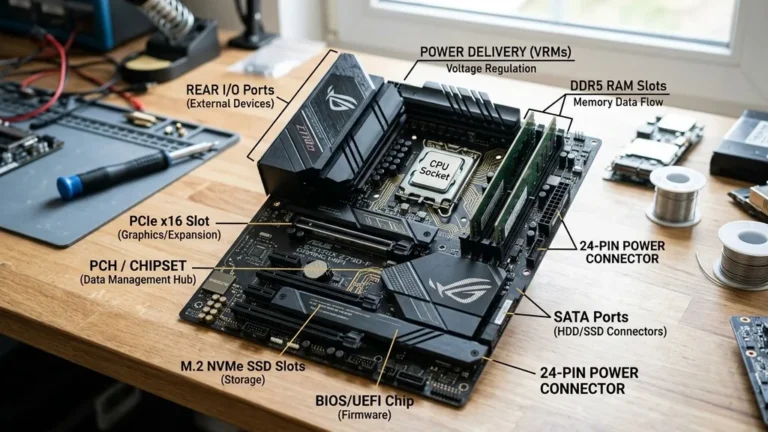

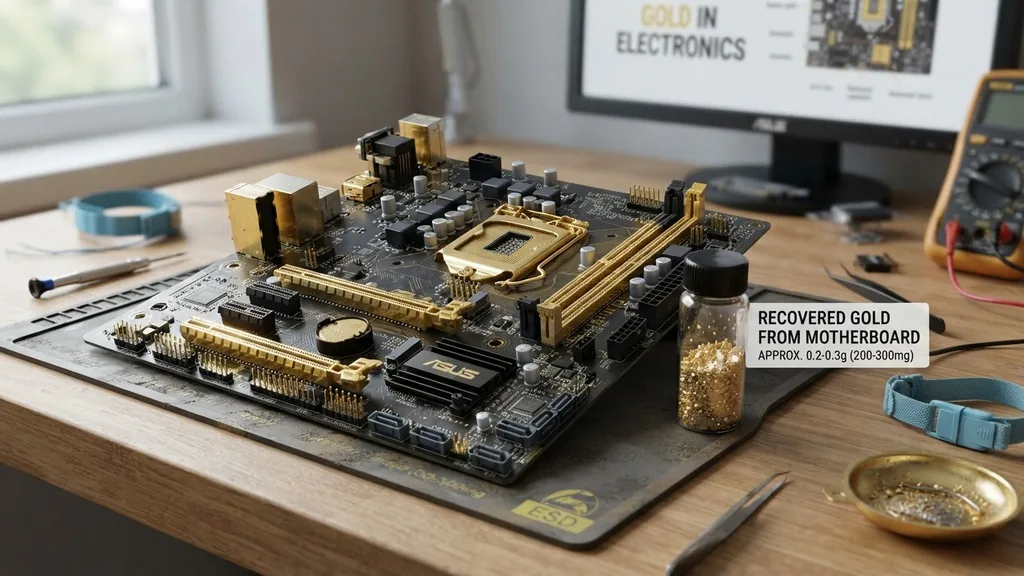
The quest to extract precious materials from discarded electronics has fueled a cottage industry of urban mining. Many people wonder how much gold is in a motherboard, imagining that a pile of old computers might be a hidden vault of wealth.
In reality, the concentration of gold in these components is surprisingly thin, requiring significant industrial processes to capture anything of substantial value. While motherboards are indeed complex assemblies of various materials, the gold content is strictly functional rather than decorative, serving as a highly conductive and corrosion-resistant layer on critical connection points.
Understanding the Role of Gold in Electronic Components
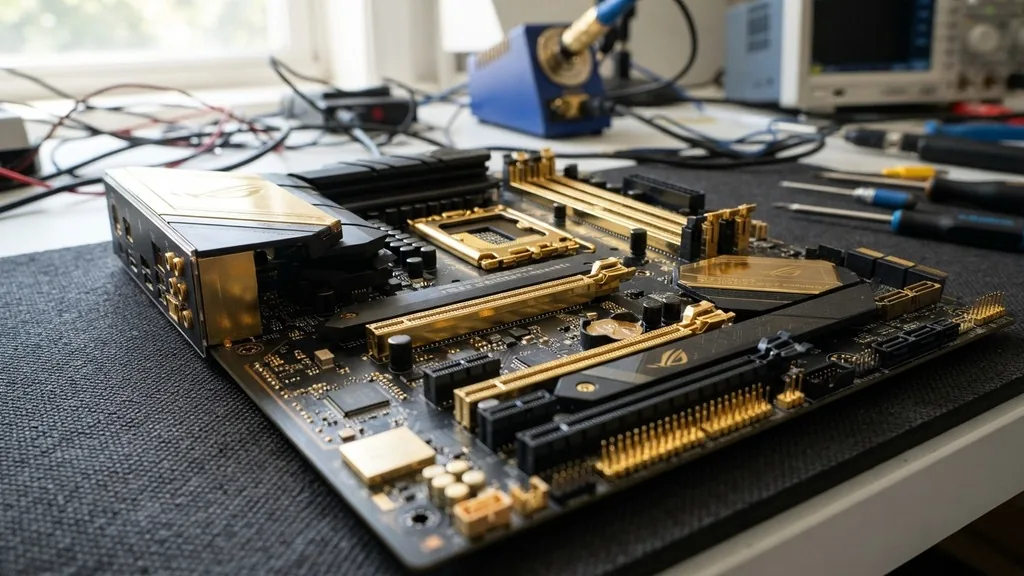
Gold is used in electronics primarily because it is an exceptionally stable and conductive metal. Unlike copper or silver, which oxidize or tarnish when exposed to air and humidity, gold remains inert. This property makes it the ideal choice for plating the delicate pins, fingers, and connectors found on a motherboard.
When you look at a motherboard, the shiny, yellow-tinted components are usually where the gold resides. These areas are designed to ensure that data signals flow without interruption over the lifespan of the device.
Manufacturers apply this metal through a process called electroplating, which deposits a layer of gold only a few microns thick. Because the cost of gold is high, engineers are incentivized to use the absolute minimum amount required to achieve a reliable electrical connection.
This is why you will rarely find solid gold parts on a board; it is always a plating or a thin layer over a base metal like nickel or copper. Understanding this microscopic application is the first step in managing expectations regarding potential recovery yields.
Quantifying the Gold Content in Average Motherboards
On average, a standard consumer motherboard contains roughly 0.01 to 0.05 grams of gold. This amount varies significantly based on the age, size, and complexity of the board. Older boards, particularly those manufactured in the late 1990s or early 2000s, often contain more gold than modern, highly integrated circuit boards.
This is due to historical manufacturing standards that favored thicker plating to ensure longevity in less stable environments. Modern manufacturing techniques have become incredibly efficient, reducing the thickness of gold plating to levels that are barely detectable without advanced analytical equipment.
To put this in perspective, you would need to process dozens, if not hundreds, of motherboards to recover a single ounce of gold. If you are looking at a high-end server board, the gold content might be slightly higher due to the increased number of connectors and slots, but the difference is rarely enough to turn a small-scale hobbyist project into a profitable venture. The precious metal content is spread across various pins, CPU sockets, and card edge connectors, making the extraction process labor-intensive and physically demanding.
The Chemistry of Extraction and Refining
The process of recovering gold from electronic waste is a complex chemical endeavor. It is not as simple as melting down a motherboard; the metals must be separated through a series of chemical baths or specialized smelting processes.
Industrial recyclers use a technique called hydrometallurgy, which involves dissolving the metals in acidic solutions to isolate the gold from the base metals, plastics, and fiberglass that make up the bulk of the board. Because these acids are hazardous and the fumes produced during the process are toxic, this work is strictly regulated.
For those interested in the technical standards of material recovery, you can refer to the Environmental Protection Agency guidance on electronics recycling to understand the environmental implications of handling these materials. Professional refineries use precise control systems to minimize waste and maximize recovery, ensuring that the heavy metals found in circuit boards are managed safely. Attempting to extract gold at home often results in the loss of the metal and the creation of dangerous chemical waste, as DIY methods rarely achieve the efficiency levels of industrial-grade equipment.
Comparing Gold Yields Across Different Hardware
Not all components are created equal when it comes to precious metal content. While the motherboard is a primary target for urban miners, other parts of the computer system often hold higher concentrations of gold.
CPU chips, for instance, are notoriously rich in gold compared to the motherboards they plug into, as the gold is used inside the package to wire the silicon die to the pins. RAM sticks also feature gold-plated edge connectors, which are a concentrated source of the metal.
The following table highlights the relative concentration of gold in various computer components, demonstrating why some parts are more prized than others.
| Component | Relative Gold Content | Ease of Extraction |
|---|---|---|
| Motherboard | Low (Broad surface area) | Difficult |
| CPU Processor | High (Concentrated) | Moderate |
| RAM Sticks | Medium (Edge connectors) | Easy |
| PCIe Cards | Medium (Edge connectors) | Easy |
As indicated by the table, the motherboard serves as the foundation for the system, but the value is often concentrated in the peripheral components that connect to it. A professional recycler will often strip these high-value items first, selling them separately from the “low-grade” motherboard scrap.
Why Modern Boards Contain Less Precious Metal
The shift toward smaller, more efficient electronics has fundamentally changed the landscape of gold recovery. In the past, companies were less concerned with the exact volume of gold used, leading to “heavy” boards that were much more lucrative to recycle.
Today, the industry follows a principle known as “design for recovery,” yet this often conflicts with the need to minimize costs. Manufacturers are constantly experimenting with alternative conductive materials or thinner plating techniques to reduce the weight of precious metals required per unit.
This trend is a direct result of the volatility of commodity markets. When gold prices spike, manufacturers feel the pressure to find ways to reduce their reliance on the metal. This has led to the development of advanced alloys and conductive polymers that can replace gold in non-critical areas.
Consequently, the average gold content in a motherboard has been trending downward for the past two decades. If you are scavenging for gold, you will almost always find better yields in older, “legacy” hardware than in modern, sleek laptops or tablets.
The Economics of Urban Mining
When evaluating the profitability of recycling motherboards, one must consider the cost of labor, transport, and hazardous waste disposal. It is rarely a “get rich quick” scheme. To make money from this activity, an operation must have access to a massive volume of scrap electronics.
This is why professional recyclers purchase motherboards by the ton rather than by the piece. They rely on the economies of scale to offset the costs of chemical refining and environmental compliance.
For an individual, the value of a single motherboard in terms of raw gold is often measured in cents rather than dollars. Even if you manage to extract every milligram of gold, the market value of that gold, after accounting for the price of the chemicals used and the time invested, is frequently lower than the cost of the materials themselves. The real value in recycling electronics often lies in the other metals present, such as copper, which is far more abundant, though less valuable per gram than gold.
Safety and Environmental Considerations
Attempting to process motherboards for gold is an inherently risky activity. Motherboards contain not only gold but also lead, cadmium, brominated flame retardants, and other hazardous materials.
When you heat or dissolve these boards, you release these toxins into the air or create a toxic slurry that is difficult to dispose of legally. Professional facilities use closed-loop systems that capture these byproducts, preventing them from entering the local ecosystem.
If you are interested in the lifecycle of these materials, it is important to support certified e-waste recyclers. These organizations follow strict protocols to ensure that the hazardous components of motherboards are isolated and treated appropriately, while the precious metals are recovered in a sustainable manner.
By choosing responsible recycling channels, you ensure that the gold is recovered without causing long-term damage to the environment. The focus should be on resource circularity rather than individual gain.
Common Myths Regarding Gold Content
There is a pervasive myth that motherboards are “loaded” with gold and that one can simply melt them down to create gold bars. This misconception is fueled by viral videos that show dramatic, yet often misleading, demonstrations of gold recovery.
These videos frequently omit the sheer volume of material required to see any significant return and ignore the extreme dangers of the chemical processes involved. It is essential to approach this topic with a healthy dose of skepticism.
* Gold is only present as a thin plating, not as solid components.
* The amount of gold per board is measured in milligrams, not grams.
* Processing electronics requires professional chemical knowledge to avoid toxic exposure.
* Most of the “yellow” metal seen on a board is actually brass or gold-colored copper, not pure gold.
* The cost of specialized equipment for refining often exceeds the value of the recovered gold.
By separating fact from fiction, you can better understand why the recovery of precious metals from electronics is a task best left to industrial experts. While the gold is certainly there, its extraction is a sophisticated scientific process that requires high-level oversight.
Frequently Asked Questions
- Is it profitable to extract gold from old motherboards at home? Generally, no. The amount of gold is minimal, and the costs of chemicals, safety equipment, and the risk of toxic exposure far outweigh the value of the tiny amount of gold recovered. It is not a viable way to make money for the average person.
- How much gold is in a standard desktop motherboard? A typical motherboard contains between 0.01 and 0.05 grams of gold. This amount fluctuates based on the manufacturer, the age of the board, and the complexity of the circuits. It is a very small fraction of the total weight of the device.
- What other precious metals can be found on a motherboard? Beyond gold, motherboards contain significant amounts of copper, which is used for the circuit traces. They also contain smaller, trace amounts of silver, palladium, and other rare earth metals used in capacitors and semiconductors, which are also targeted during the industrial refining process.
- Why do older computers have more gold than new ones? Manufacturers in the past used thicker gold plating to ensure better connectivity and longevity for components. Modern engineering has allowed for much thinner plating, which saves costs for the manufacturer while still providing the necessary conductivity for the lifespan of the device.